Duvet Insert vs Comforter vs Quilt: Which Top Layer Should You Buy?
Compare duvet inserts, comforters, and quilts by warmth, washing, cover attachment, bed-making, storage, and realistic price bands.
For readers comparing sleep-product options before buying.
Buyer's Guide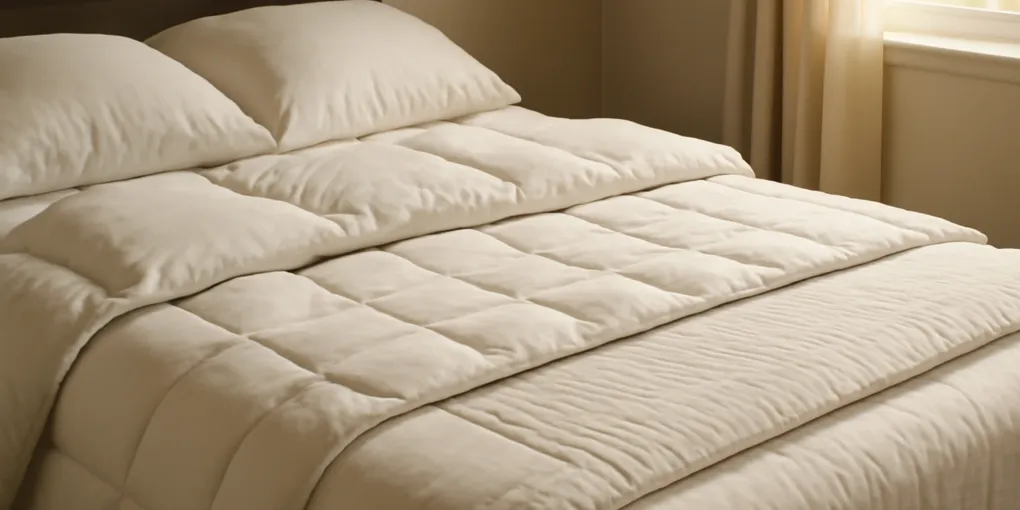
LINENSPA All-Season Down Alternative Quilted Comforter
Best modular bedding pathTarget price: $35–$90 for a queen-size down-alternative insert before the cover
Quick picks
| Product | Key Specs |
|---|---|
| See price on Amazon |
|
| See price on Amazon |
|
| See price on Amazon |
|
Product availability, certifications, and retailer details can change; check the current Amazon page before buying.
A duvet insert, comforter, and quilt can occupy the same place on a product page while creating three different laundry routines. A duvet insert is an insulating layer intended to go inside a removable cover. A comforter is a finished, filled top layer used without a separate cover. A quilt or coverlet is usually thinner, with stitched layers and much less loft.
The practical answer is straightforward: choose a duvet insert when you want a replaceable, washable outer shell; choose a comforter when one-piece bed-making matters most; choose a quilt when you want a thin layer that fits more easily in a household washer. If pressure rather than ordinary warmth is the goal, use the separate weighted blanket buying guide because weight, removal ability, and heat change that decision. If the layer will spend half the year in a closet, the seasonal bedding storage-bag guide covers breathable versus compression storage. Do not decide from “all season,” “cooling,” or “hotel” in the title. Finished dimensions, fiber percentages, fill amount, stitching, attachment points, and care instructions determine whether the bedding works in your room.
Quick decision
- Choose a duvet insert plus cover when you want to change color or wash the surface without washing the bulky insulated layer every time. The LINENSPA All-Season Down Alternative Quilted Comforter is a named starting point, but confirm that the selected listing still has the dimensions and corner loops your cover needs. See price on Amazon.
- Choose a one-piece comforter when you want the shortest route from dryer to made bed. A Bedsure Queen Comforter Set is the bounded one-piece path; confirm pack contents, fibers, dimensions, and care on the exact variant. See price on Amazon.
- Choose a quilt or coverlet when a lofty layer feels excessive, closet space is limited, or you prefer adding a separate blanket only in winter. The Love’s cabin Queen Quilt Set is a named lightweight candidate, not proof that every component is cotton. See price on Amazon.
The listed price bands are shopping boundaries, not current-price promises. Marketplace prices, coupons, sellers, colors, and sizes change. Each Amazon link is a bounded search because an exact ASIN was not used; confirm the selected listing and variant before checkout.
Fit matrix: the three purchases are not interchangeable
| Your actual need | Better starting point | Why | Checkout test |
|---|---|---|---|
| Wash the sleeper-facing surface often | Duvet insert plus cover | The cover separates from the bulky insert | Cover and insert care labels both fit your routine |
| Make the bed with one layer | Comforter | No cover stuffing, ties, or zipper | Entire comforter fits washer and dryer |
| Thin layer for a warm bedroom | Quilt or coverlet | Lower loft is easier to layer than a puffy insert | Fill weight and shell density are not hidden |
| Change color without replacing insulation | Duvet system | Covers can be swapped independently | Replacement covers exist in the exact dimensions |
| Guest room with fast turnover | Comforter or quilt | Fewer attachment points to check after washing | Wash and dry cycle fits the cleaning window |
| Small washer or shared laundry | Duvet cover or quilt | A cover or thin quilt is less bulky than a filled comforter | Dry weight and machine capacity are compatible |
| Cold room with an existing blanket | Duvet insert or comforter | Loft can add insulation over the blanket | Fill material and construction are disclosed |
| Restless sleeper who tangles bedding | Quilt or tied duvet system | A thin quilt moves as one layer; duvet ties can control shifting | Attachment points exist at all four corners, preferably more |
Start with finished dimensions, not “queen”
Bedding size labels are not exact dimensions. Two products sold as queen can differ by several inches in width and length. That difference decides whether a comforter covers a deep mattress, whether two sleepers fight over the edge, and whether an insert sits cleanly inside its cover.
Measure the mattress width, length, and total height, including a topper. Then decide how much drop you want on each side. For a shared bed, add enough width to cover both mattress sides without pulling the layer tight over two bodies. A platform bed may look right with a short drop; a tall foundation may expose the frame unless the top layer is wider.
For a duvet system, compare the finished insert dimensions with the finished cover dimensions. A loose cover lets the insert migrate and leaves empty fabric at the edges. An undersized cover compresses loft and can bow at the closure. Matching labels such as “full/queen” do not replace matching numbers.
Duvet insert: modular, but only when the parts match
A duvet system separates insulation from the visible shell. The insert supplies loft and warmth. The cover supplies color, texture, and the surface that receives most body oils, pet hair, and spills. That division is useful when the cover can be washed more easily than a bulky filled layer.
The extra work is physical. You have to align the insert, fasten internal ties or clips, close the cover, and redistribute the fill after washing. Four corner loops are the minimum useful attachment pattern. Side loops can reduce twisting on larger beds, but only if the cover has ties in corresponding positions. A listing that shows ties without stating the insert’s loop locations leaves a compatibility question unanswered.
Duvet insert checklist
- Record the insert’s finished width and length.
- Confirm the shell fiber and fill fiber separately.
- Look for the number and position of loops or tabs.
- Check whether the baffles are closed boxes or open channels.
- Read the insert care label, not only the cover instructions.
- Price the cover and insert together.
- Check that both pieces fit the washer and dryer available to you.
A target range of $35 to $90 is a useful boundary for a queen-size synthetic-fill insert, before its cover. Below that range, inspect stitching, fiber disclosure, and return terms closely. Above it, require a concrete reason for the premium, such as a disclosed fill specification, stronger construction, a longer return window, or independently verifiable material certification.
See price on Amazon. Use the result as an insert only if the exact variant publishes compatible attachment loops and dimensions.
Comforter: one-piece convenience with one-piece laundry
A comforter combines shell, fill, stitching, color, and finished edges into one item. It needs no separate cover. This is the simplest setup for a dorm, guest room, child’s room, or anyone who finds duvet covers annoying.
The compromise appears on laundry day. The entire filled piece goes into the machine. A comforter can be technically machine washable but too bulky for a home washer to move freely when wet. Crowding prevents effective washing and can leave detergent or moisture trapped in the fill. Before buying, compare the care label with your washer capacity and the drum space needed for the item to tumble.
Construction matters after repeated washing. Box stitching limits how far fill can migrate, but stitch-through boxes can create thinner lines where the shell layers meet. Baffle-box construction allows more loft but often costs more and is more common in higher-loft products. Neither term tells you the fill amount, so reject a listing that substitutes a construction buzzword for actual shell, fill, and dimension details.
A target range of $30 to $100 covers many queen synthetic-fill comforters. Sets may include shams, but pack count should not disguise a thin or undersized main piece. Compare the comforter itself, not the number of accessories in the product photo.
See price on Amazon. Select it only after checking the main comforter’s size and fibers separately from the included shams.
Quilt or coverlet: less loft, easier layering
A quilt typically sandwiches a thin fill between two fabric layers and secures them with closely spaced stitching. A coverlet can be similarly thin and decorative, sometimes with little or no fill. Marketplace titles use both words loosely, so inspect the side profile, fill description, and total weight instead of relying on the category name.
This is the most practical path when you want a thin washable layer, use a separate blanket for warmth, or need bedding that stores in less space. It also works for a warm bedroom where a lofty comforter is too much. A quilt does not actively cool the sleeper; it simply starts with less insulating bulk than many comforters.
Fiber wording needs close reading. “Cotton quilt” may refer only to the outer face while the fill is polyester. Under US textile labeling rules, generic fiber names and percentages are more useful than terms such as natural, breathable, or premium. Confirm whether each percentage applies to the front, back, and fill.
A target range of $35 to $120 is a useful queen-size quilt boundary. More elaborate stitching, cotton shell fabric, larger dimensions, or a verified material standard may raise price. Decorative stitching is not automatically durable, so inspect close photos for skipped seams and read the care instructions for shrinkage and drying limits.
See price on Amazon. Check the current face, back, and fill disclosures rather than inferring cotton from the search result or stitched appearance.
Warmth claims: translate adjectives into construction
“All season” has no single warmth value. A thin polyester comforter and a lofty down insert can both carry that phrase. The useful inputs are fill type, fill amount, loft, stitch pattern, shell density, and room conditions.
Down products may publish fill power, which describes loft relative to weight; it does not state how much down is inside the product. Fill weight tells you the amount of filling but does not describe its loft. You need both to compare down inserts meaningfully. Synthetic products often omit comparable measurements, making finished product weight, cross-section photos, and return terms more important.
For a warm room, start with the quilt or the lightest clearly specified insert. For a cold room, a warmer insert or comforter can make sense, but a separately washable blanket may offer more seasonal control. Couples with different warmth preferences often get more flexibility from separate twin-size top layers than from one king comforter marketed as temperature balancing.
Laundry is a capacity problem, not just a care-symbol problem
The American Cleaning Institute explains common care symbols for washing, bleaching, drying, ironing, and professional cleaning. Those symbols tell you what treatment the textile permits. They do not guarantee that your machine is large enough.
Before checkout, answer these questions:
- Can the item move freely in the washer when wet?
- Does the label allow the water temperature you normally use?
- Is tumble drying allowed, and at what heat?
- Can the fill dry completely in one laundry window?
- Does the cover use buttons or a zipper that needs inspection?
- Will pets, night sweating, children, or eating in bed require frequent full washes?
A duvet cover can reduce how often the insert needs cleaning, but it does not make the insert maintenance-free. Follow the insert label for spills, seasonal cleaning, and drying. A one-piece comforter is simpler to make but can require a large-capacity machine or laundromat. A quilt is usually easiest to fit, though dense cotton layers can still become heavy when wet.
What to avoid on a marketplace listing
- No finished width and length for the selected size.
- “Cotton feel” or “down alternative” with no generic fiber percentages.
- A duvet insert shown with a cover but no statement of what is included.
- Corner ties mentioned on the cover while the insert has no matching loops.
- “Machine washable” without drying instructions.
- A white insert offered in many colors with no clear explanation of whether it is actually a comforter.
- Warmth words without fill amount, product weight, or a useful return window.
- Photos of an oversized king layer attached to a queen listing.
- A set price that hides the comforter dimensions behind the sham count.
- Medical claims that a bedding layer treats insomnia, night sweats, allergies, or pain.
Final checkout checklist
Confirm these ten facts on the exact size and color selected:
- Product type: insert, finished comforter, quilt, or coverlet.
- Finished width and length in inches.
- Shell fiber names and percentages.
- Fill fiber names and percentages.
- Fill weight or total product weight when available.
- Stitch or baffle construction.
- Number and position of duvet attachment points, if relevant.
- Everything included in the package.
- Wash and drying instructions.
- Seller, return window, and price for the complete setup.
Choose a duvet insert when replaceable covers justify the extra assembly. Choose a comforter when one-piece bed-making outweighs bulky laundry. Choose a quilt when thin, washable layering is the priority. Those are concrete ownership differences; the word “luxury” is not.
Sources
- Federal Trade Commission: Threading Your Way Through the Labeling Requirements Under the Textile and Wool Acts
- Electronic Code of Federal Regulations: 16 CFR § 303.16 — Arrangement and disclosure of information on labels
- American Cleaning Institute: Fabric Care Symbols
- See price on Amazon
- See price on Amazon
- See price on Amazon
Frequently Asked Questions
- They can use similar fill and construction, but a duvet insert is designed to work inside a removable cover and should have compatible attachment points. A comforter is normally used as a finished one-piece top layer.
- A thin quilt usually contains less lofty fill than a comforter, so it is often the better warm-room starting point. Fiber, fabric density, extra blankets, and room temperature still affect warmth.
- Use the actual finished dimensions from both labels. A cover that is much larger can bunch and leave empty edges; one that is smaller can compress the insert. Twin, queen, and king names are not precise enough.