Measure a Mattress Before Shopping for a Bed Frame
Record a mattress's width, length, and height before comparing it with a bed frame's inner clearance, support rules, and room footprint.
For readers troubleshooting a sleep setup without changing prescribed care.
Protocol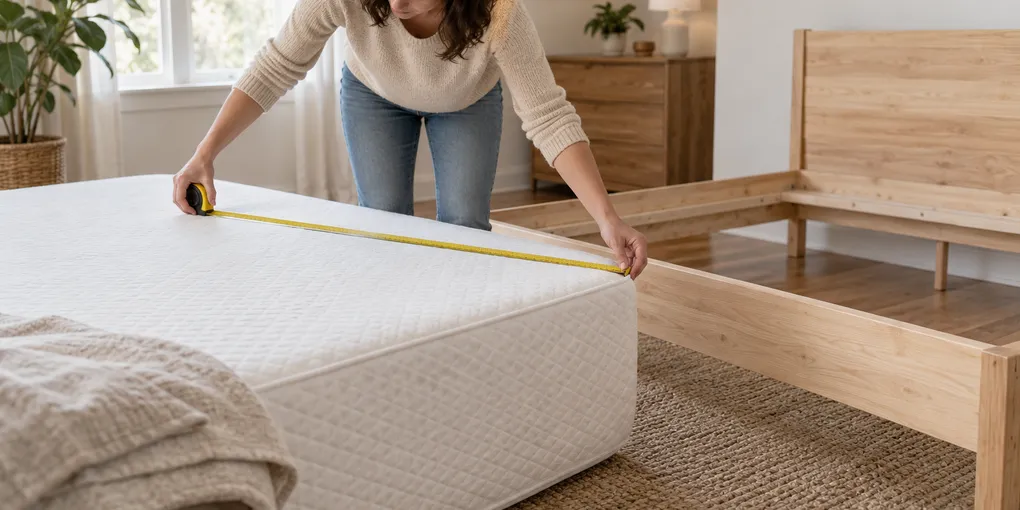
That bed frame can look right in the room and still be wrong for the mattress already in it. The practical answer is to write down the mattress’s width, length, and finished height first, then compare those three numbers with the frame’s inside dimensions and the mattress maker’s support instructions. Do that before a sale price or a tidy product photo gets to make the decision for you.
The label on the mattress is a useful starting point, not the whole measurement. A queen, for example, is commonly listed at 60 by 80 inches, but the actual product specification is the number to carry into a frame comparison. Pillow tops, border seams, and the frame’s own rails all matter once the pieces are in the same room.
Make a three-number mattress record
Strip away loose bedding so the tape can sit flat. Keep any attached pillow top in place; it is part of the mattress you need to fit. If a topper normally stays on the bed, measure its contribution separately as well, because it changes the finished height even though it does not change the mattress’s width or length.
Record these measurements in the same unit the frame listing uses:
| Measurement | How to take it | Why it matters |
|---|---|---|
| Width | Side to side across the broadest part of the mattress | Confirms the mattress can sit between the side rails. |
| Length | Head to foot, from the outermost edge to the other | Catches a too-short footboard or an unexpected gap. |
| Finished height | From the supporting surface to the top of the mattress, including any layer that will stay under the fitted sheet | Shows where the sleep surface will land against rails, a headboard, and bedside furniture. |
Saatva’s measurement guidance similarly separates height from width and length, and says to leave a topper or protector in place when it affects the measurement you need. Measure once through the middle, then repeat at an edge if a thick seam or pillow top looks wider there. Keep the larger result rather than rounding down.
Compare the frame’s interior, not its outside footprint
Frame listings often lead with the overall width and length. Those numbers help with room planning, but they do not tell you how much space exists between the rails. Find the assembly guide, dimension drawing, or support page and look for the interior clearance, slat area, or dimensions of the platform that actually holds the mattress.
Put the two records next to each other:
- The mattress width and length from its product page or your tape measure.
- The frame’s interior width and length, not the headboard-to-footboard silhouette.
- The frame’s outside footprint, including rails and any projecting headboard or footboard.
Casper’s bed-frame size guide illustrates why those are separate checks: a frame can add inches around a same-size mattress. That extra border may be welcome beside a wall, but it can also change a walkway, interfere with a closet door, or make a narrow bedroom feel pinched. Mark the outside footprint on the floor with painter’s tape if the room is tight.
Check height where the mattress meets the frame
Height creates the quiet surprises. A mattress that slides easily between the rails may sit high enough to cover part of a headboard, leave a low footboard looking shorter than expected, or raise the top surface above a nightstand. Note three points before you buy:
- the height of the frame’s slats or platform from the floor;
- the frame rail and headboard heights from the supporting surface; and
- the finished mattress height, including the everyday topper if one stays in use.
Add the first and third numbers to estimate the sleep-surface height. Then compare it with the rail, headboard, and furniture dimensions in the frame specification. This is also the point to read the mattress maker’s foundation rules. Tempur-Pedic, for instance, directs customers to confirm the exact product dimensions with the frame and specifies support requirements for a compatible base. Another brand may use different limits, so the mattress’s own care or warranty page takes priority.
Treat support as a separate fit test
A mattress can match the frame’s interior dimensions and still need a different support surface. Do not assume that every slatted frame, box spring, platform, or adjustable base meets the same requirements.
Look for the mattress maker’s stated rules about slat spacing, center support, foundation type, and total weight support. Then compare them with the frame’s construction details rather than a general claim that it is suitable for a queen or king. If the listing does not state the slat spacing or center support, ask the seller before ordering. A size label cannot answer a structural question.
Bring the record to the checkout page
Before you place the order, keep this short note open beside the listing:
- mattress width × length × finished height;
- frame interior width × length;
- frame outside width × length;
- platform or slat height; and
- the mattress maker’s required support details.
That note makes it easier to spot when a frame is describing only its exterior, when an adjustable base needs a different clearance check, or when a familiar size name is doing too much work. It also gives you useful questions for customer support before a heavy delivery arrives.
The limit of a size chart
Standard size charts are a helpful reference, but they cannot guarantee that a particular mattress, frame, topper, and support system will work together. Use the current manufacturer specifications and assembly instructions for the exact products in your cart, especially when the mattress has an unusual height, the frame has close rails, or the support requirements are detailed.